 Posted by
 In todays’ blog I would like to share somewhat belated but still relevant highlights from Neuromarketing World Forum 2022.
Before we dive into the conference conversations, I should highlight that neuromarketing research is not only about being a shiny tool, but it also represents very complex research methodologies which require a lot of technical knowledge. Of course, it doesn’t mean that only neuroscientists in organisations can run neuromarketing research in collaboration with specialised agencies. However, it still requires strong background knowledge, continuous education, and supervision from more experienced team members.
As we know, attention in general and eye-tracking research in particular continues to play an important role in the advertising industry, and it is not a surprise that this field is developing so fast and provides a diversity of tools and solutions to run different types of eye-tracking studies. From my experience, we can run eye-tracking research in a variety of ways.
The first way is to use a stationary eye-tracker or eye-tracking glasses in an in-lab setting. If you decide to proceed with this kind of study, my advice is to be particularly careful when using smaller screens of mobile phones since they require some very precise tools.
The second way you can run eye-tracking research is with different webcam eye-tracking solutions. If you decide to proceed this way, pay close attention to what exactly is measured – overall eye or pupil movements. Both approaches can be insightful, but in the first case the study will be showing whether a consumer is looking at the screen and in the second case where on the screen a consumer is looking. It’s also important to remember that webcam eye-tracking data is still very noisy and not as precise as from stationary eye-trackers, and hence requires higher sample sizes.
The third way is to use AI eye-tracking prediction models that predict results of bottom-up attention (note that there are two types of attention: bottom-up and top-down).
In terms of eye-tracking research, Doctor Ingrid Nieuwenhuis from AlphaOne shared a very good summary on the ways AI eye-tracking prediction models can help advertisers to predict results of how effective advertising can be in driving consumers’ attention.
The picture below shows where various eye-tacking prediction models can provide the most insight to marketing professionals.
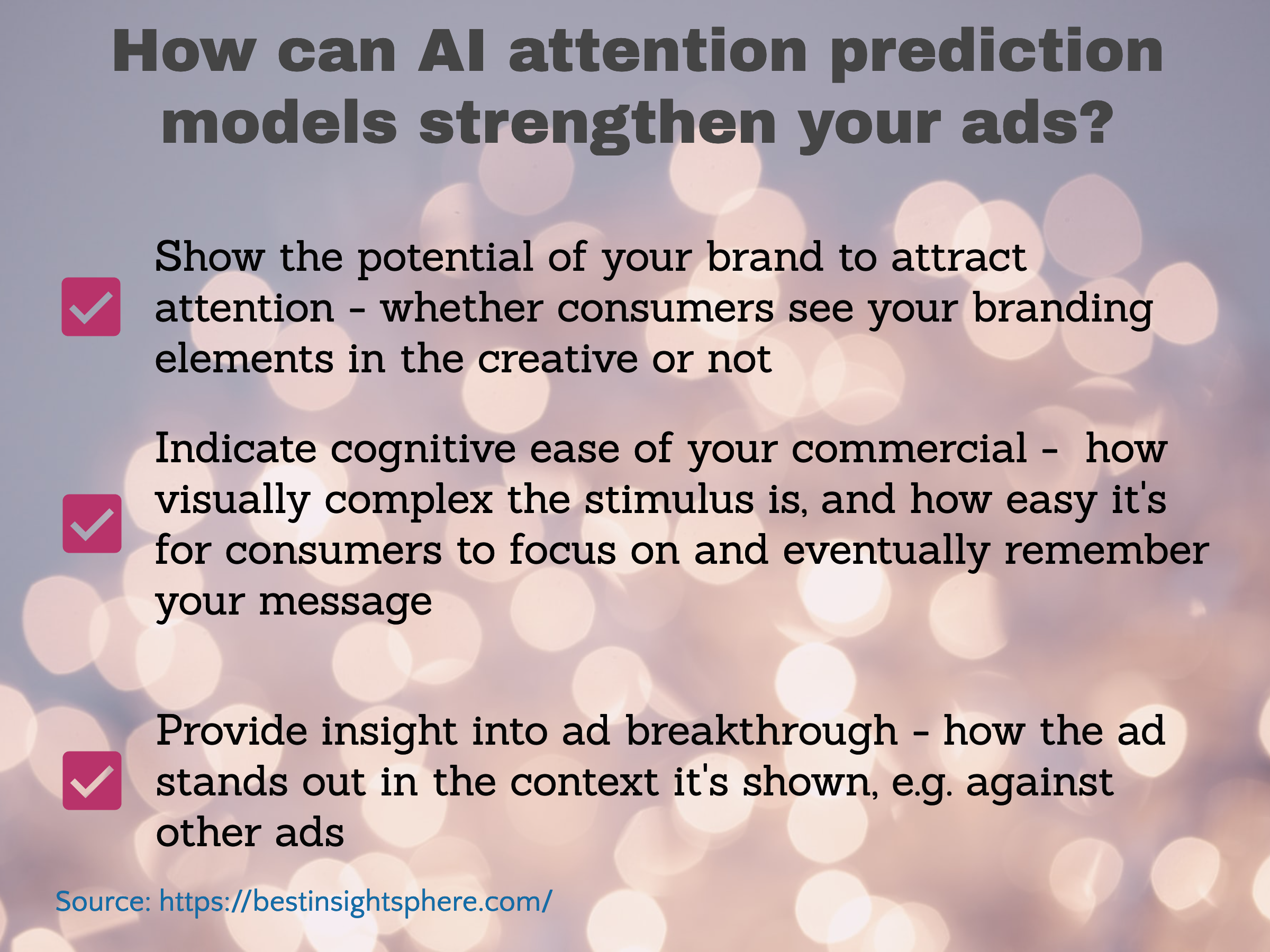
Interestingly, Doctor Ingrid Nieuwenhuis mentioned that their research shows that visuals or video scenes with high visual complexity are associated with lower EEG engagement scores and that scene changes make attention and engagement scores go down.
Another important technology which provides valuable insights to marketers is EEG (which stands for electroencephalogram, used in the form of a cap with some number (e.g. 32, 64) of electrodes, and which measures electrical signals produced by the brain).
In his presentation, Ale Smidts, who is a Marketing Research Professor at RSM Erasmus University, highlighted that EEG still has a role to play in ad testing and provided a quick overview of the key EEG metrics that can be used for this purpose.
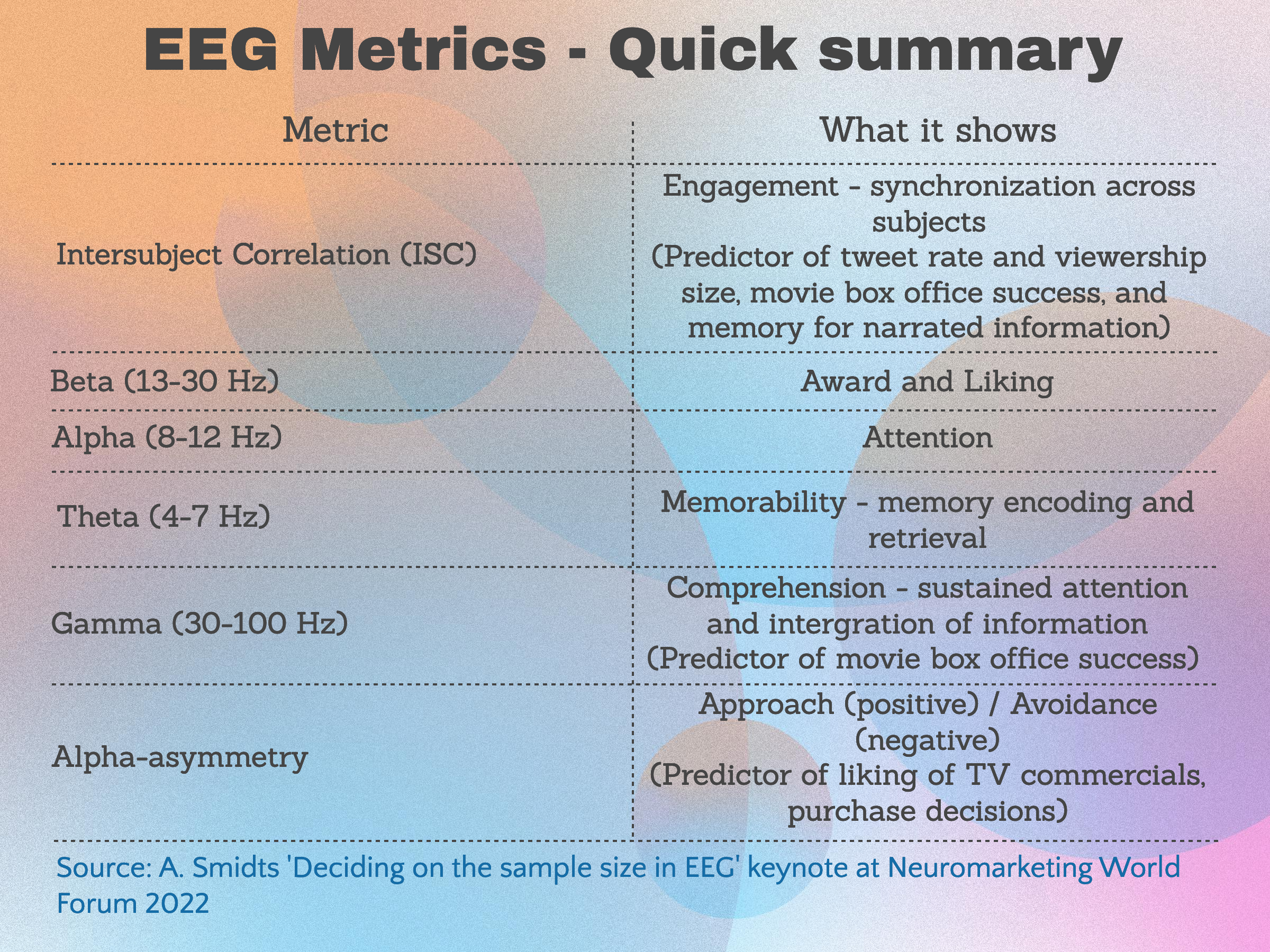
The Intersubject Correlation (ISC) metric, which is one of the most important in neuromarketing research, shows synchronisation among participants when they are watching an ad. It’s been found that the higher the synchronisation is, the more engaging is the ad. This means that marketers can use the ISC metric to understand the potential of an ad to stand out and identify the most engaging scenes within a creative.
Measuring Alpha, Beta and Theta waves allows marketers to identify whether a creative can stand out from the clutter and eventually be effective in driving key brand metrics. In addition, Aline Simonetti from the University of Valencia highlighted in her presentation the importance of measuring Theta waves to understand potential cognitive conflict (the higher the Theta, the more incongruent the ad), which is also shown to relate with memorability.
Professor Ale Smidts also shared results of his study around the reliability of EEG metrics, which was conducted on a large EEG dataset. Importantly, we need to remember that EEG provides quite noisy results and hence we need to approach the reliability of EEG with caution. That’s why it’s important to average data across participants and stimuli and run research with multiple views per commercial (at least 2, but preferably 3) and use samples with 30-40 respondents. It is also important not to forget that video duration plays an important role in EEG study design, as EEG data has a lag of 75-250 milliseconds.
The reliability analysis presented by Professor Ale Smidts was done both on the consistency of the differences in EEG metrics between commercials and the consistency of peaks and troughs in EEG metrics for dynamic patterns. The table below shows the main outcome of this analysis, which highlights that reliability increases with a larger sample size and differs markedly between metrics. It also provides guidance on the necessary sample size to achieve reliability (measured as an average Pearson correlation coefficient r over 10 000 iterations) of study results of more than 0.75 with 2 views per video.
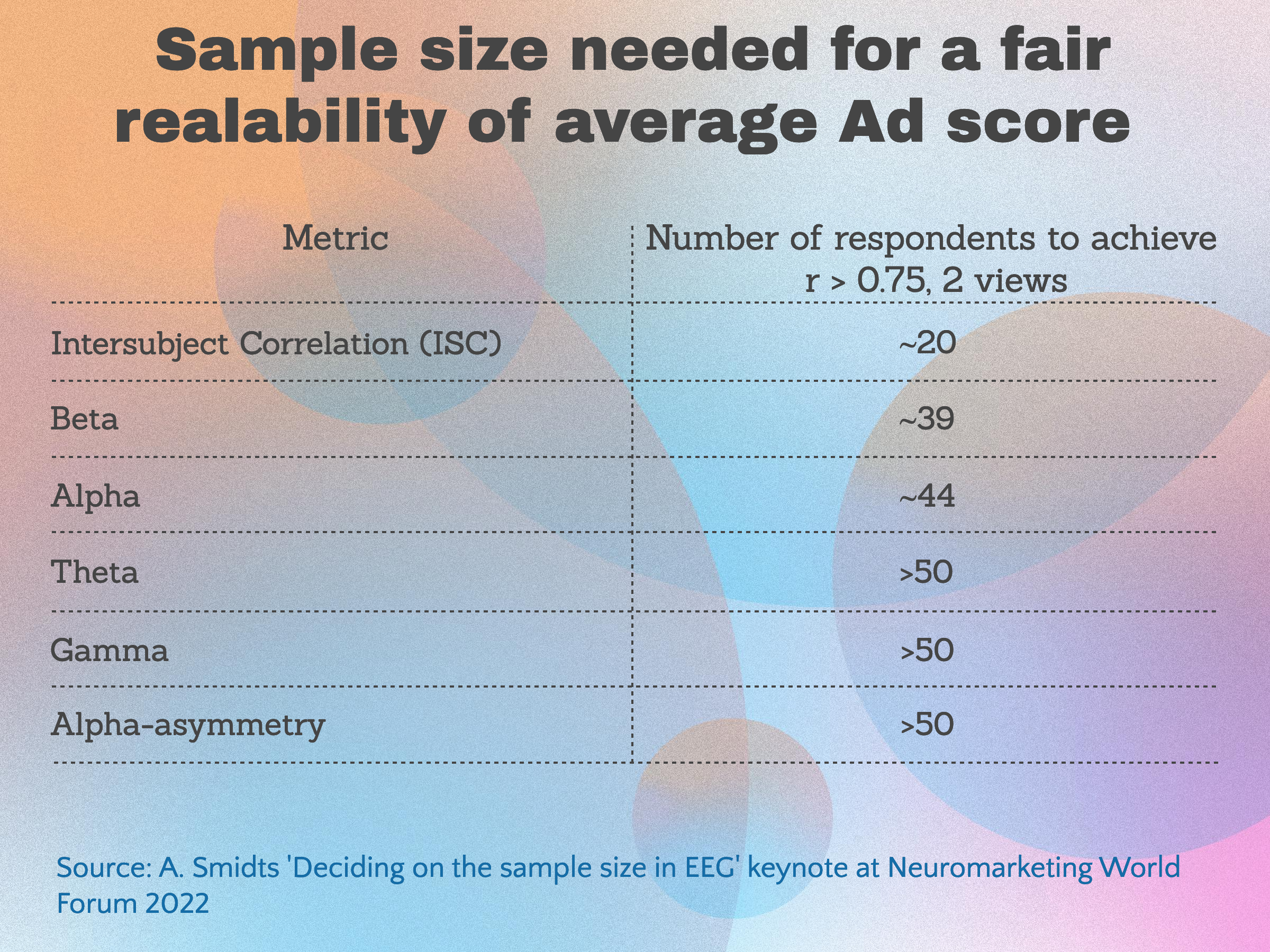
Overall, the analysis shows that the ISC metric has good reliability and also requires the least sample size (30-40 respondents) to achieve a 0.75 reliability of results. Alpha, Beta and Theta can be considered as fairy reliable metrics. It should be sufficient to recruit 30-50 respondents for ad differentiation analysis results to achieve 0.75 reliability. However, larger samples are required to achieve 0.75 reliability for dynamic patterns.
To conclude, keynote presentations at Neuromarketing World Forum 2022 highlighted the importance of careful consideration of neuromarketing research methodologies to achieve reliable results that can also provide highly impactful business guidance especially in terms of creative optimisation and enhancements. Once made correctly, marketers get very powerful insights on how to accomplish shifts in key brand metrics, especially around memorability which is shown to be linked with in-market sales (see an example here).
 Enriched Insights
One comment