 Posted by
 In this second blog post with highlights from Neuromarketing World Forum 2022, I have decided to focus on some specific case studies which used different neuromarketing tools, and blend it with my experience.
Before a neuromarketing study is launched and impactful insights are identified, it’s very important for researchers to remember that strong experimental design and clear stimuli need to be developed. In one of my previous posts, I shared my experience with applying design thinking for the development of experiments and research stimuli. In a nutshell, always pre-test for your test.
As we discussed in the previous post about the conference highlights, blending eye tracking with EEG can uncover very actionable insights for marketers. In the keynote presentation, Professor Benny B. Briesemeister shared how eye-tracking and EEG research can help to optimise a newsletter template. In this case, gaze pattern from eye-tracking research, and memorability and liking related metrics from an EEG study, helped to decide what to put in the newsletter and where it should be located. These also provided an indication regarding what blocks and types of messages in the newsletter are the most beneficial. The picture below summarises recommendations on how to design an effective e-mail newsletter template.
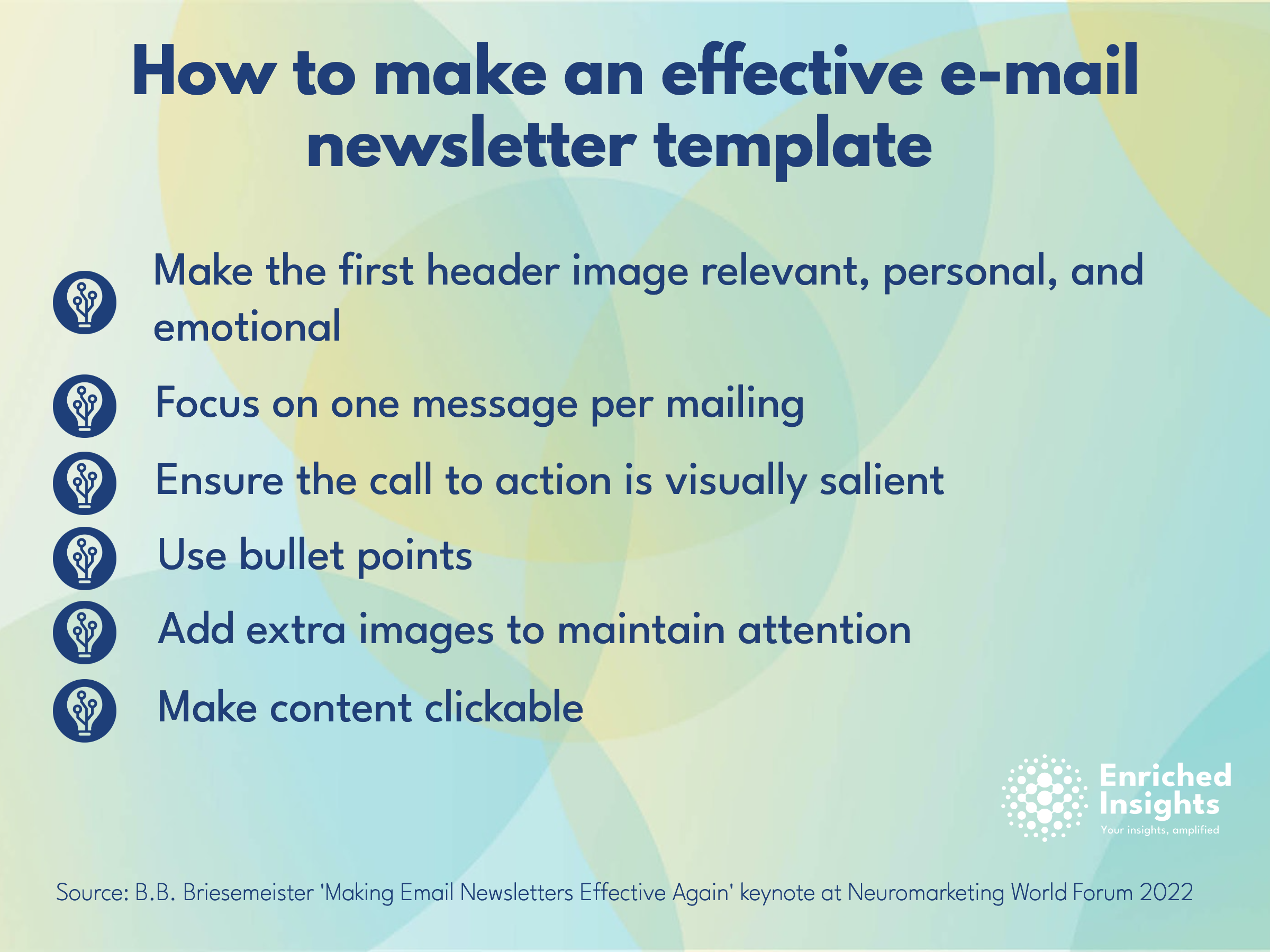
Interestingly, the study results shared by Professor Benny B. Briesemeister also indicate that a single point of negative association in a newsletter doesn’t bring much impact on the overall customer experience and usually doesn’t cause e-mail bounces.
Use of biometrics is another set of methodologies quite frequently used in neuromarketing research. The most commonly used methodologies are heart rate (HR) and electrodermal activity (EDA). EDA, also known as Galvanic Skin Response (GSR), has been found to be highly collinear with pupil dilation, and is considered in the academic literature as a measure of arousal and engagement related with activity in brain structures such as the amygdala, ventromedial prefrontal cortex, and insula (Medes, 2009; Ramsoy et al., 2017). The most commonly used method for measuring EDA is via skin conductance.
For neuromarketing researchers, it might also be useful to know that biometrics research tends to be culture agnostic (results are consistent regardless of the culture a person is from) and that it’s possible to run biometrics studies without a baseline. Interestingly, it has also been found that data synchronisation for EDA data can be used in the same way as with EEG data to understand how engaging the stimuli are (see more on EEG synchronisation here).
At the conference, Rich Timpone from Ipsos shared another interesting case study, which blended behavioural data and survey data to study cognitive conflict. These two can’t be classified as neuromarketing methodologies but they are quite often combined together with other tools to provide a very holistic perspective on the ‘how’ and ‘why’. In the case of studying cognitive conflict, marketers can understand how to drive behaviour change and how to ensure that it has a long-lasting effect. In the proposed methodology to study cognitive conflict, Rich Timpone blended response time with an anticipated regret survey and mouse tracking analysis.
The concept of anticipated regret refers to experiencing the regret that consumers may feel in the future about the decision they are making now. Marketers can leverage understanding of the anticipated regret to evaluate the potential effectiveness of the intervention and to understand individual propensity to behaviour change, which can be leveraged for creating further consumer segments (e.g. consumers who are open to buy new products or switch from one brand to another). Thus, the higher the probability of the decision conflict, the higher the probability of behaviour change.
In conclusion, neuromarketing research leverages a variety of tools and methodologies which can provide very in-depth and actionable insights for marketing professionals. For the success of your project, it’s very important to ensure a very robust experimental design and clear and reliable stimuli, and never shy away from blending your neuromarketing tools with more traditional methods like surveys and behavioural data gathering.
Sources:
Medes, W.B. (2009). Assessing Autonomic Nervous System Activity. In: E. Harmon-Jones, J.S. Beer, ed., Methods in Social Neuroscience, 1st ed. New York: The Guilford Press
Ramsoy, T.Z., Jacobsen, C., Friis-Olivarious, M., Bagdziunaite, D., Skov, M. (2017). Predictive Value of Body Posture and Pupil Dilution in Assessing Consumer Preference and Choice. Journal of Neuroscience, Psychology and Economics, 10(2&3), pp. 95-110
 Enriched Insights