 Posted by
 As companies are facing more and more challenges with their marketing budgets, Return on Advertising Spend (ROAS) becomes a topic that awakes many Chief Marketing Officers (CMOs) at night. Nowadays, budgets are getting tighter, business objectives are becoming higher, and the only way to find a solution to this situation is to start investing marketing money much smarter than ever before.
The good news is that there is a lot of room for finding ways to drive efficiency! For instance, the latest LIONS (2023) whitepaper shows that there are a lot of opportunities in finding higher efficiency even within traditional marketing channels. According to the report, almost a quarter of marketing leaders (23%) said that they can’t evaluate or use only qualitative measures to understand the effect of on-line video, and this number grows to 40% for sponsorships and 52% for PR [2].
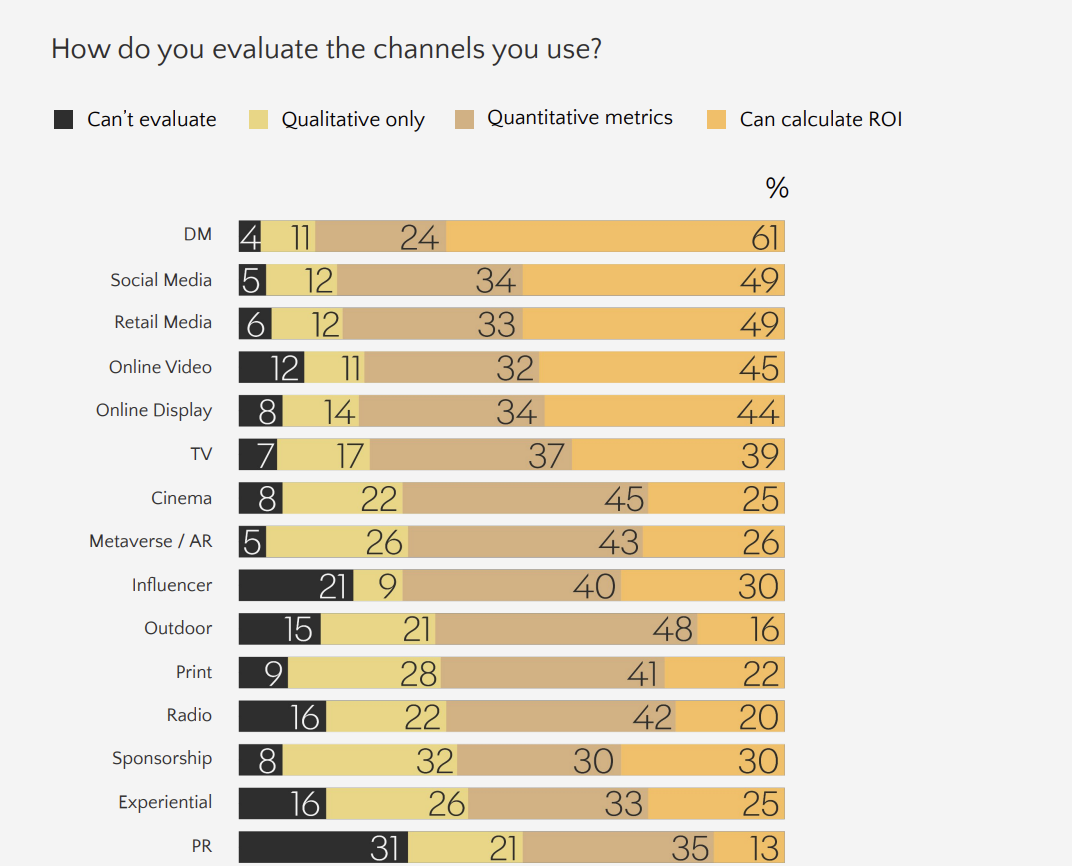
Source: LIONS, (2023). Marketing Challenges Whitepaper
During MRS ‘AI | Data | Analytics Virtual Summit’ Katrin Werres from Google also highlighted the point that there is a constant evolution in the methods to which companies are leaning in order to evaluate effectiveness of their marketing spend [3].
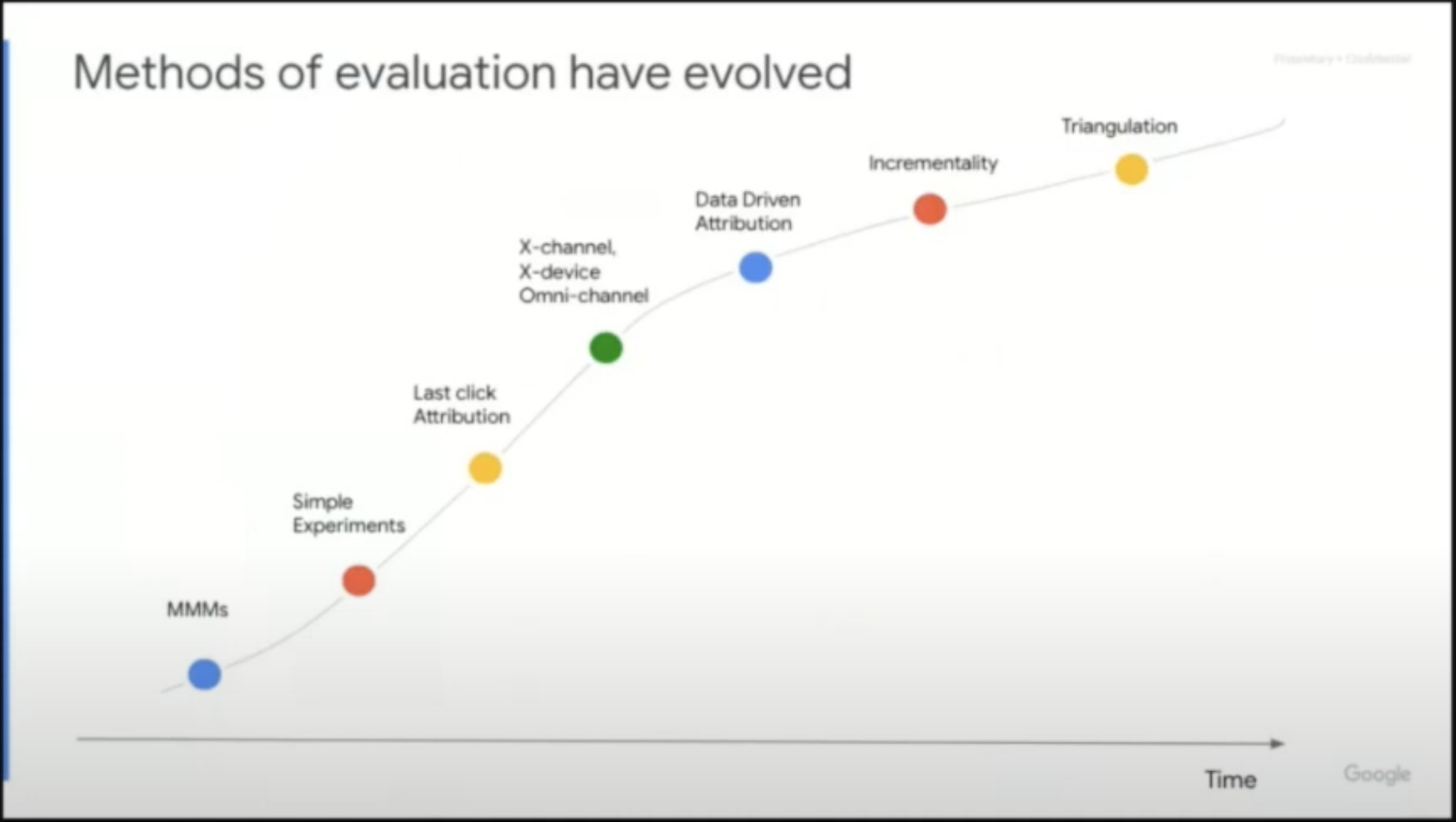
Source: MRS ‘AI | Data | Analytics Virtual Summit’ presented by Werres, K. and Gulati, N from Google.
While looking at this evolution of measurement methods, we can easily notice that there is no silver bullet or universal approach across various types of companies and industries in the way they build understanding of their marketing effectiveness and efficiency. Eventually, this makes companies end up with inconsistent and unreliable measurement methods.
For example, if we look at simple experiments as an approach to measuring the effectiveness of your marketing spend, we will have to spend a lot of time and effort to understand all the details of the experiment set-up. Your results and action steps might vary drastically depending on how well this methodology is implemented. Of course, simple experiments may not even be possible in some cases. For example, for a brand mostly relying on traditional media that now wishes to measure the incremental uplift of a social media only campaign on their sales, measuring the uplift resulting from the social media campaign would be very difficult without stopping advertising on other channels for a substantial amount of time.
For marketers it’s also important to remember that the changes in the measurement industry are happening constantly, and one particular approach may become more popular and prominent than another. Therefore, sticking to the foundations (also to ensure comparability of your results!) and focusing on the data quality are the top two determinants of your long-term success.
Thinking about measurement continuity and building your measurement foundations, it might be beneficial for you to invest into multiple technologies to measure the effectiveness of marketing spend. However, each of these methods need to go through an in-depth internal validation to allow you to understand whether it allows you to address your specific business questions, whether it fits into your overall measurement framework, and whether it can guide your long-term and strategic decision-making.
If we take B2B professional services as an example, we can definitely question the ultimate benefit of conversion modelling, especially when it focuses on cross-platform conversions. Moreover, in this case when purchase decisions usually take several months and involve a number of business stakeholders, it might be even more important to first define the notion of conversions for this type of business, and then decide whether it’s really worth investing a lot of resource and effort into this.
While considering what specific measurement technologies and methods will be the most beneficial for your business, it might be useful to review which specific marketing metrics have stronger connections with the commercial ones. The upper funnel marketing metrics are definitely a good example here, and I expect a lot of interesting research to take place in this area to unlock its true long-term value for businesses. At the same time, it’s critically important to avoid shifting the focus from the big picture and strategic business questions to conversations solely focused on specific metrics and KPIs. And, again, marketers and analytics professionals should always prioritize the quality of their data, especially now that it is extremely complex and there is so much of it regardless of the size of the business.
Finally, another reason to invest in your data quality and data skillset in your organization is, of course, the development and growth of AI tools for business decision-making. In this case, issues with poor data quality get amplified to enormous degrees such that addressing them might require a lot of resources. Interestingly, according to a recent LinkedIn study, we’re witnessing more LinkedIn members around the globe adding AI skills to their profiles than ever before. Thus, in June 2023, the number of members who claim AI skills was 9x larger than in January 2016, globally. [1].
Sources:
1. LinkedIn, (2023). Future of Work Report. [online] Available at: https://economicgraph.linkedin.com/research/future-of-work-report-ai
2. LIONS, (2023). Marketing Challenges Whitepaper. [online] Available at: https://www.lionscreativity.com/advisory/marketing-challenges-report
3. Werres, K., Gulati, N. (2021). AI | Data | Analytics Virtual Summit [Webinar]. Market Research Society. Available at: https://www.mrs.org.uk/ondemand/ai-data-analytics-virtual-summit-on-demand
 Enriched Insights